
MESSAGE OF HIS HOLINESS POPE FRANCIS FOR THE 110th WORLD DAY OF MIGRANTS AND REFUGEES 2024
08 August 2026
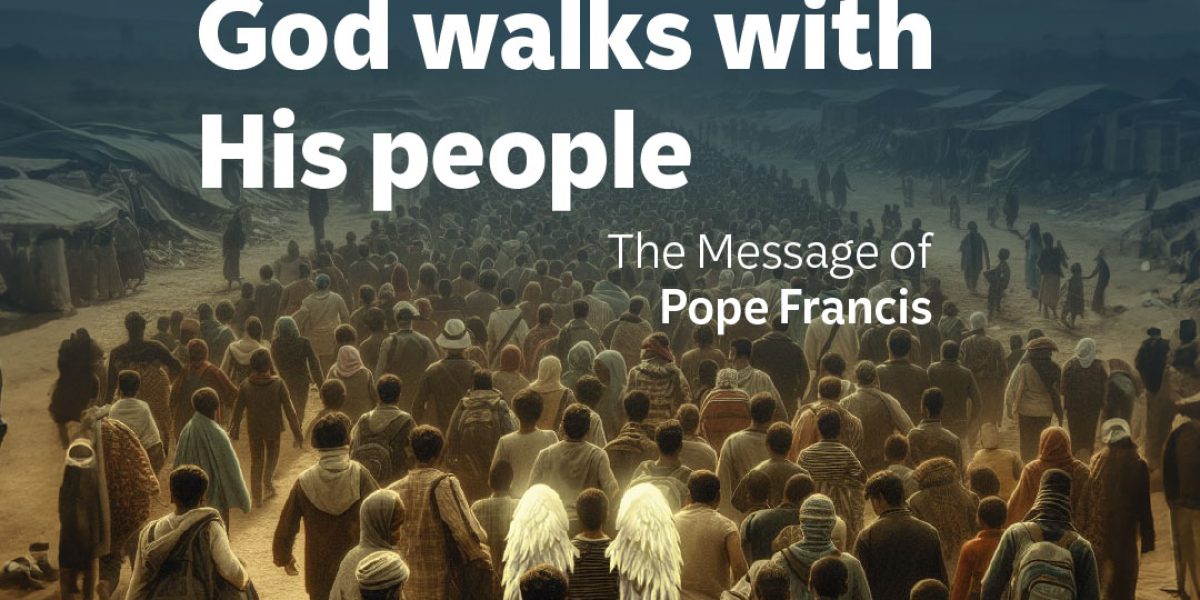
MESSAGE OF HIS HOLINESS POPE FRANCIS FOR THE 110th WORLD DAY OF MIGRANTS AND REFUGEES 2024
(Sunday, September 29, 2024)
God walks with His people
Dear brothers and sisters,
On October 29 of last year, the First Session of the 16th Ordinary General Assembly of the Synod of Bishops concluded. This session allowed us to deepen our understanding of synodality as part of the Church’s fundamental vocation. “Synodality is primarily presented as a common journey of the People of God and as a fruitful dialogue between charisms and ministries in service of the coming of the Kingdom” (Synodal Report, Introduction).
Emphasizing the synodal dimension allows the Church to rediscover its pilgrim nature, as the People of God journey through history on pilgrimage, “migration,” we might say, toward the Kingdom of Heaven (cf. Lumen Gentium, 49). The biblical story of the Exodus, which describes the Israelites on their way to the Promised Land, naturally comes to mind: a long journey from slavery to freedom, symbolizing the Church’s journey toward its final meeting with God.
Likewise, it is possible to see in the migrants of our time, just as in those of every era, a vivid image of the People of God on their way to their eternal homeland. Their journeys of hope remind us that “our citizenship is in heaven, and from there we await a Savior, the Lord Jesus Christ” (Phil 3:20).
The biblical Exodus and the images of migrants share similarities. Like the people of Israel in Moses’ time, migrants often flee oppression, abuse, insecurity, discrimination, and lack of opportunities for development. Like the Israelites in the desert, migrants face many obstacles on their journey: they are exhausted by thirst and hunger; they are worn out by work and illness; they are tempted by despair.
Nevertheless, the fundamental reality of the Exodus, of every exodus, is that God presents and accompanies His people and all His children at all times and places. The presence of God among the people is a certainty in the history of salvation: “The Lord, your God, goes with you; He will never leave you nor forsake you” (Deuteronomy 31:6). For the people who left Egypt, this presence manifested in various forms: a cloud and fire to guide and illuminate their way (cf. Ex 13:21), the tent of meeting which protected the ark of the covenant, making God’s closeness tangible (cf. Ex 33:7), the pillar with the bronze serpent that ensured divine protection (cf. Num 21:8-9), manna and water (cf. Ex 16-17) as gifts from God for His hungry and thirsty people. The tent is a particularly beloved form of God’s presence. During King David’s reign, God chose to dwell in a tent, not a temple, so that He could walk with His people, “from tent to tent and from dwelling to dwelling” (1 Chronicles 17:5).
Many migrants experience God as their companion on the journey, their guide and anchor of salvation. They trust Him before they set out and seek Him in times of need. In Him, they find comfort in moments of despair. Thanks to Him, there are good Samaritans along the way. In prayer, they entrust their hopes to Him. How many Bibles, copies of the Gospel, prayer books, and rosaries accompany migrants on their journeys through deserts, rivers, seas, and borders of every continent!
God not only walks with His people, but He also dwells within them, in the sense that He identifies with the men and women on their journey through history, especially with the little ones, the poor, and the marginalized. In this, we see an extension of the mystery of the Incarnation.
For this reason, encountering the migrant, as with any brother or sister in need, “is also an encounter with Christ. He Himself said this. He is the one knocking at our door, hungry, thirsty, a stranger, naked, sick, and imprisoned, seeking to meet and be helped” (Homily, Mass with Participants in the Meeting “Free from Fear,” Sacrofano, February 15, 2019). The final judgment in Matthew 25 leaves no doubt: “I was a stranger and you welcomed me” (v. 35); and again, “Truly I tell you, as you did it to one of the least of these brothers and sisters of mine, you did it to me” (v. 40). Every encounter along the way represents an opportunity to meet the Lord; it is a moment laden with salvation, because Jesus is present in the brother or sister in need of our help. In this sense, the poor save us, for they allow us to meet the face of God (cf. Message for the Third World Day of the Poor, November 17, 2019).
Dear brothers and sisters, on this day dedicated to migrants and refugees, let us unite in prayer for all those who have been forced to leave their homes in search of dignified living conditions. Let us walk together with them, being “synodal” together, and entrust them, as well as the upcoming Synodal Assembly, “to the intercession of the Blessed Virgin Mary, a sign of sure hope and comfort for the faithful People of God as they continue their journey” (Synodal Assembly Report, 16th General Assembly: Continuing on the Path).
Prayer
Lord, Almighty Father,
We are Your pilgrim Church
journeying toward the Kingdom of Heaven.
We live in our homeland, but as though we are strangers.
Every foreign land is our home,
but every native land is foreign to us.
Though we live on earth,
our true citizenship is in heaven.
Do not allow us to become possessors of the part of the world
that You have given us as a temporary home.
Help us to continue walking,
together with our migrant brothers and sisters,
toward the eternal home You have prepared for us.
Open our eyes and hearts so that every encounter with those
in need becomes an encounter with Jesus,
Your Son and our Lord.
Amen.
Rome, St. John Lateran, May 24, 2024, Feast of the Blessed Virgin Mary, Help of Christians
FRANCIS